Narita to Tokyo With Luggage: N'EX, Skyliner or Bus?

Updated: Oct 25
Quick choice: match the transfer to your hotel area
Use this shortlist before comparing tickets. It is an editorial starting point, not a fastest-route promise. Check the service on your travel date, then compare the journey all the way to your hotel entrance.
Your hotel or priority | Check this first |
Near Tokyo, Shinagawa, Shibuya or Shinjuku Station | N'EX: does your actual train stop at the station you need? |
Near Keisei-Ueno or Nippori | Skyliner: compare the final walk or onward transfer, not just the airport ride. |
A bus stops conveniently for your hotel | Check that operator's exact stop, baggage acceptance and departure. An airport bus is not automatically a hotel shuttle. |
Lower-cost arrival via Tokyo Station | TYO-NRT: adult regular-service fare JPY 1,500; late-night/early-morning service JPY 3,000. |
Useful distinction: the TYO-NRT airport departure uses tickets for a particular bus, but seating is unassigned. Buying the ticket does not choose a numbered seat. Follow the operator's separate last-bus instructions when applicable.
November 6–8, 2026: JR East's construction notice, rechecked October 25, lists affected N'EX services with changed operating sections. Confirm the train number and city stop, including a return to the airport.
Compare the same thing: total fare in Japanese yen, changes with all bags, final walk and usable departure time. A headline rail time or a promotional fare alone cannot tell you which trip is easier.
If your room is not ready, decide where the luggage will go before adding sightseeing. Our Tokyo luggage-storage comparison gives named options, prices and gate-access checks.
Shortlist and TYO-NRT fare/seating details checked October 25, 2026. Other source dates below apply to their own sections. This is not a live journey planner or a promise of seats, space or hotel access.
Short answer: Choose your Narita transfer from the hotel entrance backward.
N'EX and Skyliner offer different city arrival points, Access Express is a different Keisei service, and a bus only simplifies the day if its actual stop suits your accommodation.
Compare the terminal connection, ticket requirements, bags and final walk—not just the advertised airport journey time.
Narita is not Haneda. Arriving at HND instead? Use our Haneda-to-Tokyo transfer guide.
If you have guides for both airports saved, check the airport code and arrival terminal before buying anything.
A sensible option for one hotel may be a tiring detour for another. The method below helps you narrow the choices without pretending one service is best for everybody.
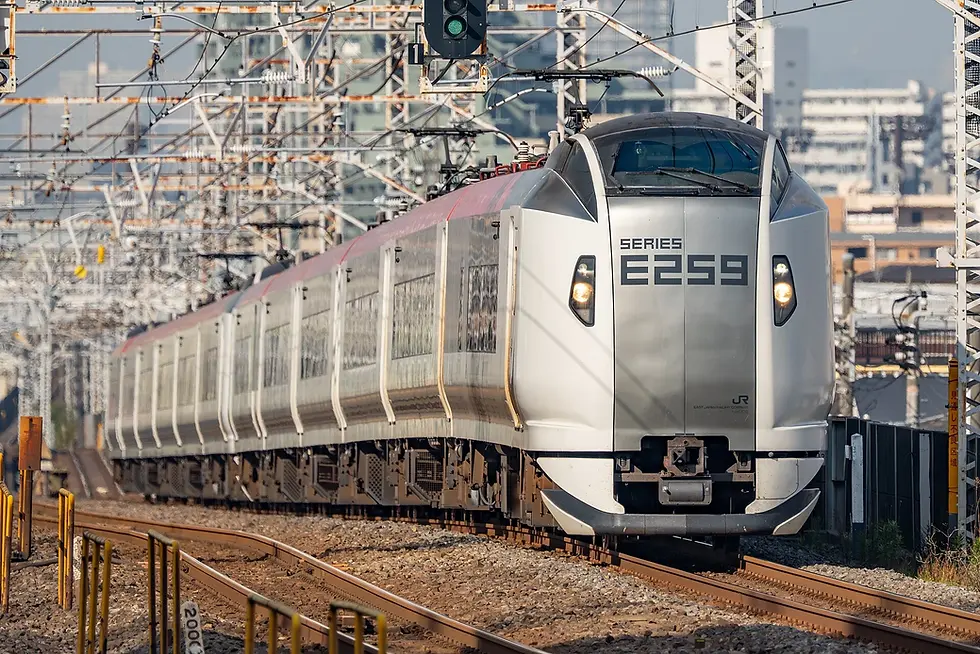
Narita Express E259 train at Motoyawata, photographed 24 May 2024. Photo: Takeshi Aida / Wikimedia Commons, CC BY-SA 4.0. Cropped by Yuqiao; resized and converted to WebP for this guide, under the same license.
Reference photograph, not a FIRST FILM JOURNEYS client image or an airport boarding-location map.
Start with the hotel, not the train brand
Save the full hotel name, Japanese address, reception entrance and check-in instructions. Then identify a useful arrival station or bus stop. Do not stop at “Tokyo”: Tokyo Station, Keisei Ueno and a bus terminal are not interchangeable destinations.
Compare two complete plans. For each, write down airport-terminal access, waiting, the main ride, any interchange, the final exit and the walk with luggage.
Decide which difficulties matter most to your group: extra tickets, stairs, a long outdoor walk or the possibility of standing.
For example, a traveler staying near Ueno should investigate the Keisei arrival points; someone considering a direct train to Shinjuku should inspect the actual N'EX service.
These are starting questions, not guaranteed door-to-door recommendations. Check your precise hotel and travel date.

Compare the trip to your hotel entrance, not just the airport ride. Editorial illustration, not an official route map.
Match Narita's terminal to the rail station
Narita's official rail page distinguishes Narita Airport Station for Terminal 1 from Narita Airport Terminal 2・3 Station. Terminal 3 does not have a separate railway station inside its building.
For Terminal 3, include the connection to the shared station. The airport publishes a walking route between Terminals 2 and 3 and free terminal shuttle information.
Check the right shuttle direction, stop and operating hours. Walking with a stroller or several bags is a different task from following a map alone.
Save a screenshot of the actual terminal route. Do not replace it with a generic airport illustration: our diagrams explain the choices, not the building layout.

Terminal 3 has no separate railway station in its building. Follow the airport’s current walking or shuttle guidance; this is not a building map.
N'EX: check the destination and the whole ticket
JR East's N'EX guide lists city destinations including Tokyo, Shinagawa, Shibuya and Shinjuku. Verify the booked train's stops and operating notices; do not assume every service goes to your preferred station.
The ticket guide separates the basic fare from the limited-express ticket. An IC-card balance alone is not the complete N'EX ticket.
It also describes a product with an unspecified seat: that is not a guaranteed seat reservation, and you must yield a seat to its reservation holder. Ask for a reserved seat if that certainty matters.
N'EX has large-luggage space, but JR East says capacity is limited and luggage may not fit. Keep essential documents and valuables accessible. A seat reservation is not a reservation for unlimited suitcase space.
Current notice, checked 8 October 2026: JR East flags changes to some N'EX services on 6–8 November 2026. If your dates overlap, inspect the construction notice and affected trains.
The affected route depends on the date and train; some services start or terminate at Tokyo instead of continuing to Shinjuku or Ōfuna. Check the onward connection as well.
Skyliner and Access Express are not the same service
Keisei's Skyliner overview describes reserved seating, luggage areas and access via Nippori and Keisei Ueno.
Look at what happens after that arrival point. A short airport ride can still leave an inconvenient transfer or hotel walk.
Access Express is a separate service for which Keisei says the limited-express supplement is not required. Check the departure's destination and stopping pattern.
Do not buy a Skyliner product and treat it as instructions for every Keisei train, or assume a similarly named service includes the same seat arrangement.
Use the operator's planner for the full destination and actual date. Compare the fare product, not just a large “from” price or the word “express.” Our IC-card guide explains why stored value and an express ticket are different questions.
Buses: match the stop and the luggage rules
Narita's departure-bus directory organizes stops by destination. Find the route first, then open that operator's current timetable, boarding instructions and acceptance conditions. A route serving a neighborhood does not necessarily stop at your hotel.
For a concrete example, TYO-NRT's riding guide lists an adult regular-service fare of ¥1,500 and a late-night/early-morning fare of ¥3,000, checked 8 October 2026.
Check which category applies.
Its airport-departure instructions differ from city-departure instructions; follow the current counter and final-bus payment guidance rather than assuming all departures use one process.
The operator FAQ says underfloor luggage is generally limited to about one suitcase per person and identifies items it will not accept.
Its luggage notice also excludes valuables, precision equipment and items such as power banks from the underfloor compartment.
Confirm unusual luggage before choosing this bus. These are TYO-NRT conditions, not rules for every airport coach.
Road conditions can affect arrival. Allow room before another fixed booking, and include the walk from the actual city stop. Keep what you need during the ride outside the stored suitcase.
Landing time is not departure time
You still need to leave the aircraft, complete arrival procedures and collect bags before reaching transport. There is no reliable universal immigration buffer. Avoid promising yourself a connection based only on the flight's scheduled landing time.
For a late arrival, check the last complete journey: not only the airport departure, but also the city connection and hotel access.
Save a workable alternative and confirm late check-in.
A licensed transport quote, an agreed accommodation arrangement or a changed first-night plan must be checked separately; this article books none of them.
The airport's overnight-access page distinguishes terminal areas and opening hours. An accessible terminal area does not mean a city train runs overnight or accommodation space will be available.
Before you leave arrivals
Confirm your terminal, train or bus destination, complete ticket, accepted bags, final exit and backup. Save those details offline. If you need a step-free route, check each stage—not merely whether the city station has an elevator.

A flight’s landing time is not the time you reach transport. Check the complete connection and a workable backup.
Continue with station exits and meeting points and luggage storage planning. Avoid scheduling a photo session immediately after a tight flight-to-hotel transfer.
To discuss a private experience, share your dates and practical needs.
Our photography prices are quoted in US dollars; operator transport charges are separate and payable in their stated currency, usually Japanese yen.
Sending an inquiry does not confirm a booking or take payment.
FAQ
Can I board N'EX with only Suica or PASMO?
No: an accepted IC card can cover the basic fare, but you still need the appropriate limited-express ticket. Check whether your product includes a reserved seat; an unspecified-seat ticket does not guarantee an empty seat.
Is Terminal 3 Station inside Terminal 3?
No. Terminals 2 and 3 share the railway station at Terminal 2. Include the walking or shuttle connection in your plan and follow the airport's current access guidance.
Is the cheapest airport fare the cheapest hotel transfer?
Not necessarily. Add the onward fare and consider the actual stop, luggage rules and final walk. A low first-leg price is poor value if it leaves your group with an unsuitable transfer or an unworkable late connection.
Source check: 8 October 2026. This is editorial planning guidance based on the linked airport and operator pages, not a report of a personally traveled route.
Timetables, charges, seat products and baggage conditions can change. Reconfirm for your actual journey.


Comments