3 Beautiful Japanese Gardens in Tokyo Beyond the Usual Stops

Updated: Oct 26
Short answer: for beautiful Japanese gardens in Tokyo beyond the usual sightseeing stops, consider Tonogayato's wooded valley, Kyu-Yasuda's compact pond landscape or Kiyosumi's water-and-stone views. Choose the scenery you want and a location that fits your day.
These are established public gardens, not places tourists have never discovered. Their appeal is the chance to notice another Tokyo: branches over water, a bridge glimpsed through leaves and a carefully composed view that changes as you walk.

Tonogayato pond: Irina Gelbukh, 2011, CC BY-SA 3.0. Reference photograph, resized for display; card crops may differ. Not our client image or a report of current conditions.
Choose your garden by the view—and your route
Choose Tonogayato for a sense of descending into a green miniature valley. It is in Kokubunji, western Tokyo: a deliberate outing, not a quick detour from Asakusa.
Choose Kyu-Yasuda for a smaller garden stop around Ryogoku. Its pond, stones and red bridge offer a different scale of scenery, with the surrounding city still part of the picture.
Choose Kiyosumi for a generous pond view, carefully placed stones and the pavilion across the water. It works naturally with time in Kiyosumi-Shirakawa, rather than a dash across Tokyo to collect gardens.
Tonogayato: a green valley behind the station
The surprise is the change in level and atmosphere. The garden's official guide describes bright lawn above, then woodland and a spring-fed pond below, using the natural terrace landscape rather than flattening it.
Look for the transition, not only the postcard angle. Open space becomes a canopy of leaves; water and rocks draw the eye inward. A wide view tells that story more clearly than a close-up of one attractive leaf.
Maples and bamboo contribute to the setting, but this is not an autumn-only destination. Green foliage can be the main attraction. Leaf color, flowers and the condition of paths vary; no photograph establishes what will be there on your visit.
Practical details: the manager lists 9:00 a.m.–5:00 p.m., last entry 4:30 p.m., standard general admission ¥150 (JPY), and closure December 29–January 1. Kokubunji Station is a listed two-minute walk; use its south exit.
The terrain is notably uneven. Check the official barrier-free map and ask about the route you can actually use if steps, slopes or a stroller matter. The garden specifically asks that young children be accompanied by a guardian.
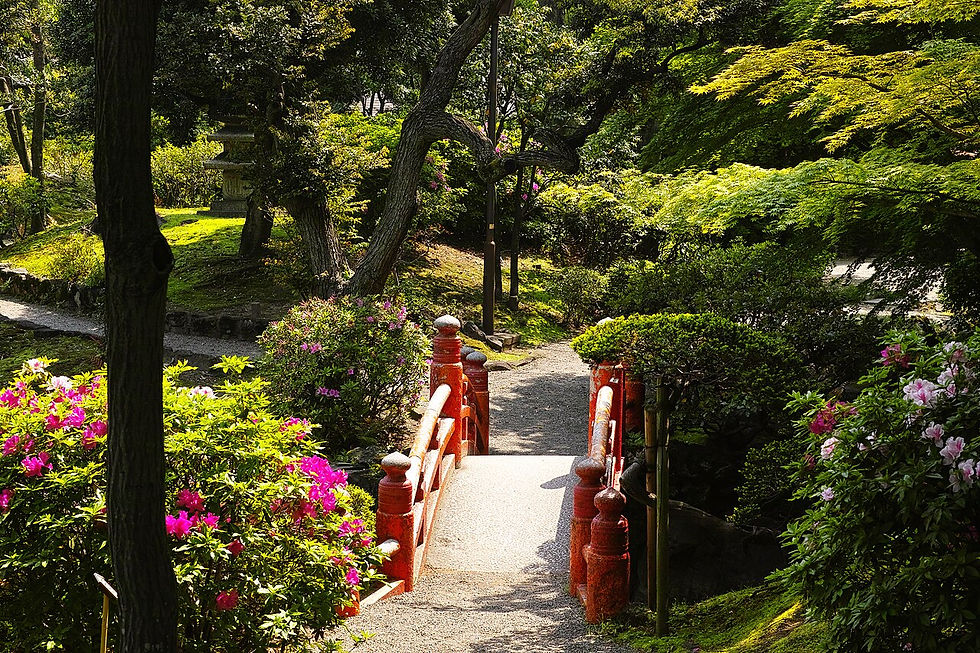
Red bridge at Kyu-Yasuda: bethom33, 2017, CC BY-SA 2.0. Reference photograph, resized for display; not a current-condition guarantee or our client photograph.
Kyu-Yasuda: a pond garden with the city around it
A red bridge among green branches is an inviting detail, but the larger story is water. Sumida City's official page explains that the garden's historic tidal effect is now recreated artificially.
This is not an untouched wilderness hidden from Tokyo. Let the urban setting be part of the experience. Move around the pond and compare a view framed by trees with one that admits the surrounding buildings.
GO TOKYO lists admission as free and places it a short walk from Ryogoku Station. The Japanese Sword Museum is beside the garden, but museum admission, opening days and bookings are a separate check.
The easy-to-miss timing detail: Sumida City lists 9:00 a.m.–7:30 p.m. in April–September and 9:00 a.m.–6:00 p.m. in October–March, but only part of the garden opens after 4:30 p.m. It closes December 29–January 1.
For a full garden visit, plan around that partial-access cutoff—not just the later closing time. Illumination is listed after sunset, but later access does not promise every path or your preferred viewpoint.

Kiyosumi's waterside pavilion: Irina Gelbukh, 2011, CC BY-SA 3.0. Reference photograph, resized for display; not a recent scouting report or our client image.
Kiyosumi: water, stones and a pavilion across the pond
Here the pond gives the composition room to breathe. The official garden guide highlights its water, notable stones and pond-edge stepping-stone feature. The Ryotei pavilion gives the opposite bank a distinctive architectural focal point.
Try looking before lifting the camera. Notice the relationship between a near branch, the water's surface and the distant building. A reflection is an opportunity when conditions allow, not something the pond owes you on a windy day.
Practical details: standard general admission is ¥150 (JPY), with usual hours 9:00 a.m.–5:00 p.m. and last entry 4:30 p.m. The annual closure is December 29–January 1. Kiyosumi-Shirakawa Station is a listed three-minute walk.
Do not mistake the pavilion for a walk-in café or assume every picturesque building is freely accessible. Consult facility information separately. Use the garden's accessible-route information rather than assuming the pond-edge stones are necessary to enjoy the view.
Path-work dates, not a permanent closure: the manager's October 16 notice scheduled work below Fujisan for October 22–23, 2026. Those planned dates have passed; the notice alone does not establish today's path access.
Choose the route before the photo: open current notices and the official garden page's English/French and barrier-free maps. Save the relevant map offline, then check entrance signs instead of assuming a complete pond circuit.
Show staff: 「今日はどの道が通れますか?」 — “Which paths can I use today?”
Reading: Kyō wa dono michi ga tōremasu ka?
Build one satisfying visit—not a cross-city checklist
For an east-Tokyo day, Kyu-Yasuda or Kiyosumi can be the garden anchor. Consider the other only after checking the actual onward route, your energy and access hours. They are separate visits, not one continuous garden walk.
For Tonogayato, make western Tokyo the point of the outing. A station-to-gate walk of two minutes says nothing about the complete journey from your hotel. Add transfers, finding exits and any walking limitations before deciding it is nearby.
As an editorial planning allowance, reserve an unhurried hour inside your chosen garden, plus travel and a buffer. This is not an official visit duration.
A slow photographer or a family may want longer; a late arrival may need a simpler plan.
Neither Tonogayato nor Kiyosumi is normally a sunrise-access garden. If you want an early start, our Tokyo breakfast planning guide helps you work around opening times without treating a queue as harmless spare time.
Photograph the atmosphere without spoiling it
Our three-frame exercise: take one wide view showing the garden's shape, one layered view with foreground branches and distant water, and one small detail such as stone texture. Compare them before chasing another location.
Stay on permitted paths, avoid blocking bridges and let other visitors pass. Do not climb a stone or cross a barrier to remove someone from the frame. A quiet-looking image is not evidence that the garden was empty.
Casual sightseeing pictures and a directed portrait session are not interchangeable. Kiyosumi's photography notice distinguishes ordinary souvenir/landscape photographs from uses requiring an application, including portrait and pre-wedding shoots.
Tonogayato requires advance application for model shoots and prohibits cosplay photography. Sumida City also requires an application for shoots using a garden area for a period, such as pre-wedding photography. An entrance ticket does not grant those permissions.
For a private experience, explore our Tokyo photo plans and share the scenery and pace you prefer. These gardens are not promised included venues; location suitability, access and any permissions must be confirmed in the written plan.
Before you go: a five-minute check
Access: open the manager's latest notice and map. Record the garden name, entrance, normal hours, last entry and any partial-access cutoff. A search-result closing time is not enough.
Conditions: check weather and current garden notices, not a fixed “best foliage date.” Rain can change footing; strong wind changes water reflections. Our rainy-day photo guide helps you keep a fallback.
Route and purpose: confirm the station exit, step-free needs and whether you are sightseeing or organizing a shoot. Pack light enough to move without occupying a path. Verify fees and rules directly before travelling.
For a wider choice of neighborhood atmosphere, compare our Tokyo photo-area guide. Choose the garden that belongs in your day, not the one a “secret spot” headline makes you feel obliged to collect.
FAQ
Are these gardens really unknown to tourists?
No. All three have official visitor information and are known destinations. “Beyond the usual stops” means an alternative to your own checklist, not a measured claim about visitor nationality or crowd levels.
Can I visit at sunset or sunrise?
Check actual opening hours against that day's sunrise or sunset. Tonogayato and Kiyosumi usually close at 5:00 p.m.; Kyu-Yasuda's later hours include partial access after 4:30. Special openings should never be assumed.
Which garden is best for a stroller or limited mobility?
Do not choose from a photograph alone. Tonogayato has pronounced changes in level; the metropolitan gardens publish barrier-free maps. Ask the manager about the exact entrance, usable path, assistance and facilities you need before committing.
Official details checked October 17, 2026. Photographs are credited historical references, not current seasonal conditions or FIRST FILM JOURNEYS work. No crowd survey, timed route test or exclusive garden access is claimed.
Kiyosumi path-notice wording and map availability rechecked October 26, 2026. Other garden details retain their October 17 check date; no on-site reopening verification is claimed.


Comments